Measuring the pots
For this first design, I wanted a cover for an existing pot. That meant checking the inside opening, the usable height, and the clearance all the way down, rather than scaling the outside by appearance alone.
With Codex, I prepared two versions to start: one for a nursery pot, and a smaller one that would hold the entire peach-coloured ceramic pot, including its cork base. The smaller model also received a reinforced base.
| Insert | Outside diameter | Total height |
|---|---|---|
| Peach pot + cork | 48 mm | 59.32 mm |
| Nursery pot | 81.28 mm | 78.74 mm |
The small model uses the original 48 × 59.32 mm measurements. The photographs show readings of 47.31 mm across and 58.98 mm high. The latest digital model checks leave about 1.6 mm of radial clearance for the small pot and 1.3 mm for the nursery pot. The larger fit still needs a physical check.
Diameter: 47.31 mm. The model used the earlier 48 mm measurement.
Height including the cork base: 58.98 mm. The model used 59.32 mm.
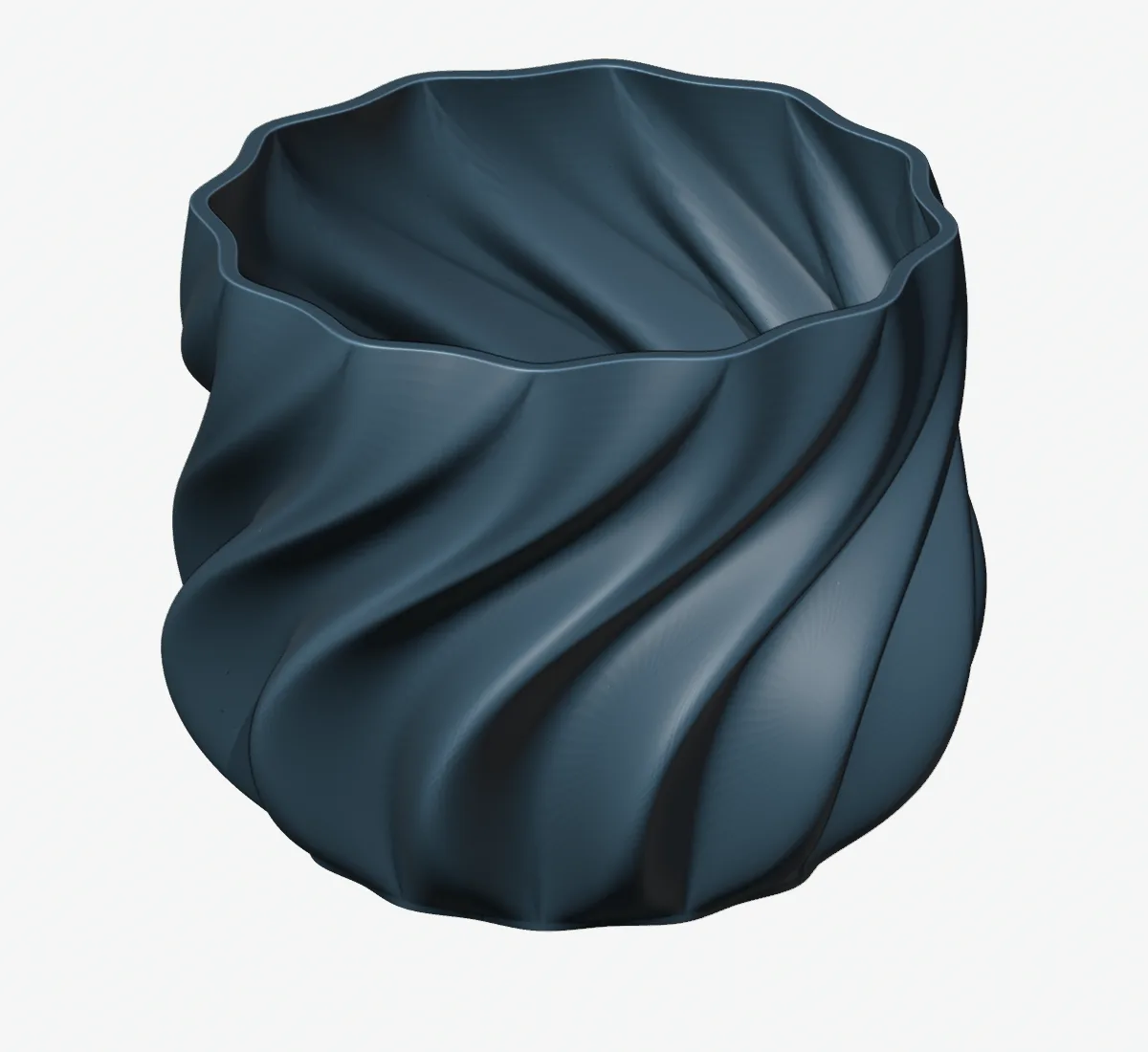
3D model preview
The adapted smaller planter before printing.
Finished small planter
I printed the smaller planter first and completed it before starting the larger one. The peach-coloured pot fitted inside.
The thicker layers are visible up close, but the curved ribs and navy colour look good at normal viewing distance. That was the finish I was happy to accept for a shorter print.
The finished small planter on the desk. The ribs and layer lines are visible.
At normal viewing distance, the layer lines are subtle and the ribbed shape stands out.
Moving to the larger planter
With the small planter finished, I turned to the larger nursery pot. Its initial slice used 0.16 mm layers and was estimated at 7 hours 27 minutes.
I wanted a shorter print and was happy to accept more visible layers for a planter viewed at normal room distance. Codex changed the layer height to 0.28 mm and adjusted the printing settings, bringing the estimate to 2 hours 34 minutes.
The faster slice called for 89.8 g of PLA rather than 87.4 g—roughly 3% more material. The compromise reduced estimated printing time, while making the layer lines more visible and using slightly more plastic.
Move queue overflow at 80%
The larger print stopped at around 80% with E0017: Move queue overflow.
Flashforge lists excessive speed and large files with many circular movements as possible contributors. The slice Codex prepared contained many short movements, making the command workload a plausible concern. I could not establish one definitive cause. Flashforge’s E0017 guidance ↗
E0017: Move queue overflow, at 80% progress.
The planter at 80%
Even at around 80% complete, I like how the navy planter looks with the plant inside. Once the printer is fixed, I’ll print the full model.
The interrupted larger planter, about 80% printed, photographed later with the plant inside.
Failed print recovery
The partial planter was still attached. Following Codex’s suggestion, I restarted the printer at the rear switch and accepted its recovery prompt. It went through heating and preparation, but when movement resumed the printhead collided with the existing part. I switched it off immediately.
That recovery failed. Temperature readings and software status had not been enough to verify that the printer would safely continue around the object already on the bed. I did not try another recovery on that part.
The recovery prompt after restarting. I stopped the recovery after the printhead collided with the part.
Warming up during troubleshooting. The target here is 210°C; the revised slice uses 220°C.
Revising the model and settings
Once everything had cooled, I removed the failed planter, inspected the printer, and cleaned the bed. Nothing looked visibly damaged. Automatic leveling then completed normally on the empty plate.
Codex simplified each model from about 2.05 million triangles to 80,000, then checked that the meshes remained closed and the pots still had clearance. A closer check also led Codex to widen the larger cover by 2.2%, to about 131.3 × 131.3 × 84 mm.
The revised large print file shrank from about 19.7 MB to 9.4 MB, with substantially fewer extrusion segments. Codex capped printing speeds at roughly 60–70 mm/s and lowered acceleration. These changes reduced complexity and motion demands, but the revised larger model had not yet completed a print.
The leveling routine, which completed normally before the next attempt.
300 layers and 10% infill. The 100% speed is a multiplier of the sliced settings, not the printer’s maximum speed.
Material and layer height
| Larger planter | Initial | Earlier faster | Later revision |
|---|---|---|---|
| Estimated PLA | 87.4 g | 89.8 g | 91.7 g |
| Layer height | 0.16 mm | 0.28 mm | 0.28 mm |
| Expected layer lines | Finer | More visible | Still more visible |
The earlier faster slice called for roughly 3% more PLA than the initial version. The latest estimate is about 4.3 g higher than the first, with the wider model also contributing. Saving estimated machine time did not save material in these revisions. Material used by failed attempts is additional, and I have not measured that total.
Prepared files after the interruption
29.1 g estimated PLA
91.7 g estimated PLA
Estimates for the revised files. The small file was revised too, although that planter was already complete. Its actual elapsed print time was not recorded.
Nozzle blockage
The revised large job heated and started. Software reported layer progress, but the head was moving without extruding filament. I paused it, and Codex cancelled the attempt.
Following Codex’s guidance, I checked the feed path and tried the printer’s heated Load function. The nozzle was reported clogged, and Codex found Flashforge’s cleaning procedure using the supplied metal pin. At the end of that evening, I had not carried out that cleaning procedure.
I cannot yet say whether the queue error or collision caused the blockage. Those were separate events observed during the evening. By then it was late, so I switched the printer off and stopped for the night. Flashforge’s extrusion troubleshooting ↗
The 0.4 mm nozzle, with navy plastic near the tip.
· Follow-up
Tracking down the filament jam
I continued troubleshooting the blockage with Codex. The printer’s loading routine did not free the filament, so I moved on to inspecting the printhead.
With the printer switched off and cooled, I removed the complete quick-release hotend assembly and the PTFE filament guide tube. The filament remained stuck inside the printhead. Attention turned to the extruder, whose feeding gears had not yet been exposed or inspected.
Inspecting the printhead. The feeding gears were still enclosed.
A heating attempt
During troubleshooting, I also tried heating the removed nozzle assembly with a lighter. White material appeared afterwards, but its identity and any damage remained unclear. The attempt did not resolve the jam.
Settings and possible causes
Codex’s faster profile requested 150 mm/s outer walls and a 250 mm/s base speed, with a 12 mm³/s flow limit and a 230°C nozzle temperature. ELEGOO’s matte PLA guidance lists 30–70 mm/s and recommends 220°C. The temperature was within its 190–230°C range, but the requested speeds exceeded that guidance, and the flow limit had not been calibrated. ELEGOO’s matte PLA specifications ↗
Excessive extrusion demand can make feeding gears grind or deform filament. Heat creep—filament softening too far up the hotend—was another possibility. Neither explanation was confirmed through inspection. Filament grinding ↗ · Heat creep ↗
The slower retry was already failing to extrude before reaching normal printing speeds, suggesting a restriction was already present. The lighter-heating attempt came after the original blockage.
I wanted a shorter print and accepted more visible layers. Codex selected the settings and recommended the recovery that ended in a collision; those choices needed validation against the filament and printer. They could have contributed to the breakdown, but the cause of the jam remains unconfirmed.
Status at this update: filament still stuck; extruder inspection pending. The small planter is complete, and the larger print remains unfinished.